Ask Your AI Assistant Whether a Contract Can Be Sold: The PumpPill MCP Server
PumpPill now answers inside your assistant. The MCP server is live at https://api.pumppill.org/mcp — Streamable HTTP, no API key, no account, nothing to install. Any client that speaks the Model Context Protocol gets twenty-four tools at version 1.3.0, twenty of them open to anyone, covering Robinhood Chain (an Arbitrum Orbit L2, chain ID 4663) and Solana.
The question it exists for is the one people ask a chatbot at the worst possible moment: someone sent me this contract, is it going to let me sell? Until now an assistant answered that from whatever it remembered, or from a page it happened to fetch. Now it can ask the index directly and quote the read, with the time the read was taken attached.
The server is published in the official MCP registry as org.pumppill/token-safety.
Connect it in one line
Claude Code: run claude mcp add --transport http pumppill https://api.pumppill.org/mcp.
Cursor (~/.cursor/mcp.json), Windsurf, Cline and anything else that takes a remote MCP server: add {"mcpServers": {"pumppill": {"url": "https://api.pumppill.org/mcp"}}}.
VS Code (.vscode/mcp.json) names the transport explicitly: {"servers": {"pumppill": {"type": "http", "url": "https://api.pumppill.org/mcp"}}}.
Claude on the web or desktop (Pro, Max, Team, Enterprise): Settings, then Connectors, then Add custom connector; name it PumpPill, paste the address, leave the OAuth fields empty. ChatGPT takes the same address as a connector and calls two tools, search and fetch.
A client that only speaks stdio bridges to it with npx -y mcp-remote https://api.pumppill.org/mcp.
That is the whole setup. There is no signup step, because there is nothing to meter — every public tool reads something already computed.
The tools
The twelve that shipped first:
rh_token_safety— the stored safety read on a Robinhood Chain contract: whether it can be sold, what is flagged and with what evidence, where the launch money went.rh_ticker_resolve— which contract is the real $NAME. This is the question that actually costs people money: the ticker is not the token, and the name is open for anyone to reuse.rh_deployer_record— has this wallet launched before, and how did those launches go.rh_flagged_recent— what the current wave of bad launches looks like, findings named.rh_stock_pairs— which memecoins are quoted in tokenized NVDA, SPY or TSLA.rh_chain_stats— how the chain measures: launches, how many survive, what happens to them.rh_whale_wallets— which wallets hold enough to move a pool. Balance read on chain, not activity inferred.rh_wallet_record— what one wallet holds and what it has traded.sol_token_detail— any Solana token: holders, bundle structure, what the developer still holds.outcomes_measured— what happened to the tokens PumpPill logged, losers included in the denominator.rh_early_walletsandsol_early_wallets— which wallets were early on the tokens that ran, with the chain's own base rate in the same answer.
Added since, through version 1.3.0:
exit_check— sellability and what the deployer can still do, on both chains.fomo_gathering— tokens that several different FOMO app traders bought inside a window, each with the first and latest buy seen, how many are still in, and PumpPill's own read. Token answers on both chains now carry afomoblock when FOMO traders traded the token.fomo_trader— one FOMO trader's week by name: buys with the market cap, sells with the profit the feed reported, and a record once fifteen buys are scored.room_calls— the list of calls PumpPill's room posted, graded, losers included, open to anyone ten minutes behind the members.whats_movingandwhats_moving_brief— gatherings, room calls and new flags in one answer; pass the previous answer's time assinceand a polling agent gets only what changed.membership_status— whether the connection is signed in, open to anyone.searchandfetch— the two tools ChatGPT calls.
Every answer about one token also carries a trade link that opens @PumpPill_Trade_Bot with that contract loaded. It is on every token whatever its read says, and the instructions tell the assistant it is not a pick.
There is also a pumppill://facts resource — the quotable fact sheet, so an assistant can describe what PumpPill is without guessing — and four prompts.
Three questions it can now answer properly
"Is 0x... safe?" The assistant calls rh_token_safety and gets the last stored read: sellable or not, the structural findings with their evidence, and scanned_at. If the contract is not in the index it returns found: false, which means we have no read on this — not this is fine. That distinction is the whole reason the tool exists.
"Which one is the real $TICKER?" rh_ticker_resolve names one contract: alive, real liquidity in the pool, not flagged at the top two severities. The other contracts wearing that name come back as a count, never as a list, because a list of lookalike addresses is a shopping menu for the wrong one.
"Do tokens like this ever work out?" outcomes_measured returns forward-measured outcomes from the moment PumpPill first logged each token — the share that doubled, that reached 5x, that never moved. Entry is the market capitalisation at logging, never backfilled, and the tokens that went nowhere stay in the denominator. It is a distribution, not a track record.
The rules that make it quotable
An MCP tool result becomes a sentence in somebody else's answer, phrased somewhere we will never see it. That shaped four rules.
- Every result carries a citation string and a timestamp. "As of" is the moment the source computed the number. Where a payload states no time of its own, the honest word is "retrieved", and that is the word it uses. A number with no date is the one thing this server was not going to ship.
- No recommendation crosses the boundary. PumpPill's own pages carry a verdict field written for a button — an action and a tone. Those are stripped. A field literally called
actionin a tool result turns into advice in a stranger's chat window. - A miss reads as a miss.
found: falseis never dressed up as a clean bill of health. - No win rates and no predictions. Outcome figures are counts with losers in them. A clear structural read is evidence, not a recommendation, and the payloads say so.
There is one more rule that is about us rather than the reader: no public tool can trigger a live scan. A cold scan spends a metered block-explorer budget, and an MCP endpoint answers unauthenticated strangers with retry loops. Every public tool reads a cached endpoint, so nothing in it can be made to cost us money. The one tool that does scan, rh_scan_now, answers a signed-in member, twenty fresh Robinhood Chain scans a day, or an agent with a wallet that pays for the one call. The server is rate-limited to 240 requests a minute per address and 60 a minute per client; past that it answers 429.
What it will not do
It covers Robinhood Chain and Solana, and nothing else. No public tool will scan a contract it has never seen — a token minted four minutes ago is a found: false until the scanner reaches it, and on a genuine miss the address is queued for reading, so ask again in a few minutes. It reports what was true at scanned_at, and on a young token that can be an hour old. It does not know what a price will do, and no tool in it pretends to.
Why we built the door this way
Through the middle of 2026, the traffic mix on our own server inverted. In September, OpenAI's GPTBot requested roughly 27,700 pages a day from us; Googlebot requested under a thousand. The readers had become assistants, and assistants had no clean way in — they were reading pages built for humans and inferring the rest.
/for-agents already served the ones that knew we existed. The MCP server is the door the rest can find, and the registry listing is the sign on it.
The paid part, stated plainly
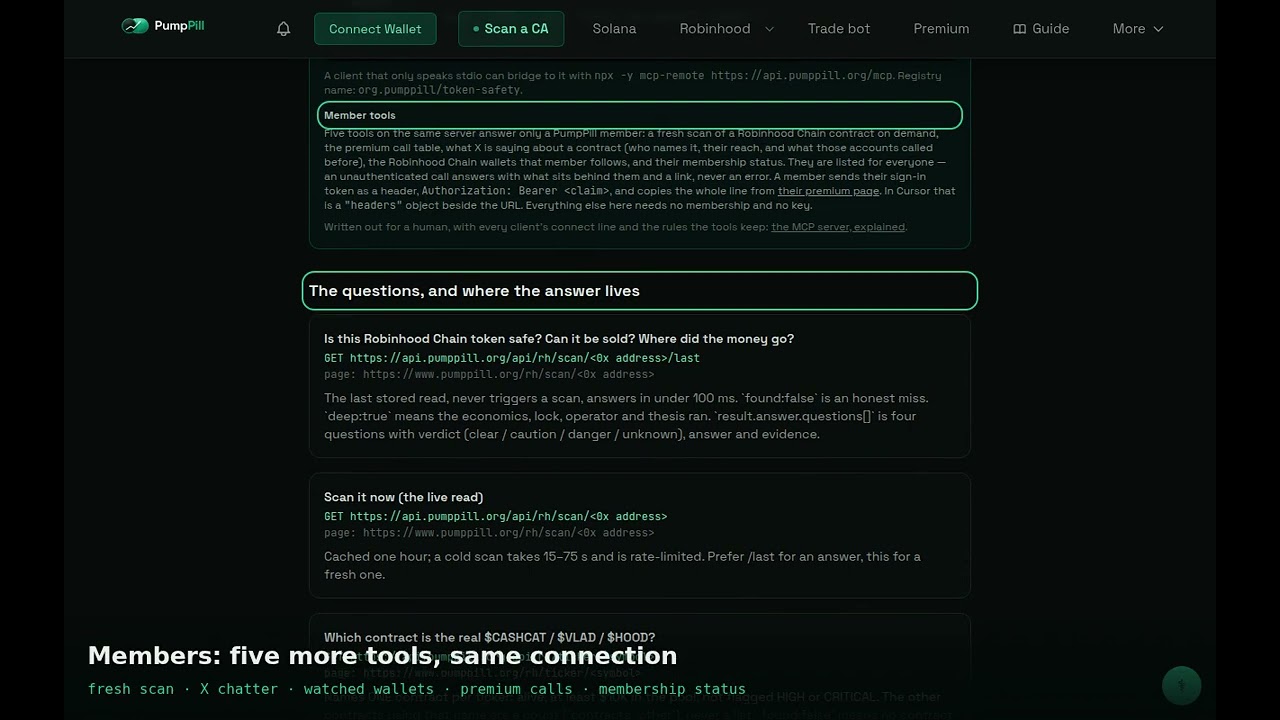
The twenty open tools carry no charge and no key. Premium is separate — the members' room and its call list, the Premium tables, Wallet Watch and a lower Trade Bot fee, $99 a month or $990 a year at the introductory price — and four further tools on the same server answer a member only: a fresh Robinhood Chain scan (rh_scan_now), the premium call table (premium_calls_recent), the Robinhood Chain wallets you follow (my_watched_wallets), and what X is saying about one contract (x_chatter). A member connects them by sending their sign-in token as an Authorization: Bearer header, and the whole line is on their premium page; Claude on the web and ChatGPT cannot send a custom header, so the member tools are for editor clients. Those four are listed for every client, so an assistant can say what is behind them; called without a membership they answer with that sentence and a link, never an error.
Three of the four can also be bought one call at a time by an agent with a wallet, in USDC on Base: a fresh scan for five cents, X chatter for five cents, the call table for ten cents. A miss, an error or a daily limit costs nothing. No tool will try to sell you anything — results carry a link back to the page they came from, and that is all.
Quote the data with attribution and a link to the page rather than the API URL. The machine-readable summary of the whole site lives at /llms.txt, and the endpoint documentation — every tool's JSON twin, with its limits — is at /for-agents.
What the video says the full transcript, for reading or searching
The lesson is the method. The product is where you apply it.